Landscape Lighting for Steep Driveways, Stone Stairs and Paths in Western NC
On a steep mountain property, landscape lighting should light every grade change clearly, the driveway edges, each stone step and the turns in a path, with warm, carefully aimed light that shows the ground without glaring into anyone’s eyes. Done well, the same system that makes the property safer after dark also shows off the stone, the trees and the house. The key is placing and testing the light at night, on the actual slope, before anything is installed.
In Western North Carolina, driveways climb, stone stairs connect levels and paths wind between walls and trees. Those are the places people trip after dark, and some of the best features on the lot.
Why do steep driveways, stairs and paths need their own lighting plan?
- Every change in level is a trip risk. A step you can see in daylight can disappear at dusk, especially stone that blends into the ground around it.
- Slopes change how light falls. A fixture that lights a flat walk evenly can throw glare straight into the eyes of someone climbing toward it, or leave the step below in shadow.
- Distances are long. Mountain driveways and paths can run a long way from the house, and wire runs that are not planned properly lead to uneven light.
- Weather is hard on equipment. Rain, freeze-thaw cycles and leaf fall are hard on cheap fixtures and loose connections, and frost can shift stakes.
How should a steep driveway be lit?
The goal is to show where the driveway goes and where its edges are, without turning it into a runway. Light along the edges and at the turns helps a driver read the curve. Light where the driveway meets the parking area and the entrance shows people where to get out and which way to walk.
Restraint matters here. Too many bright fixtures down a driveway can look harsh from the road and from neighbors’ homes. Controlled beams and warm light keep it on your property and looking natural.
How do you light stone stairs safely?
Stone stairs are common on Asheville area properties, and they are worth lighting carefully. The aim is to show the edge of each tread clearly so you can see where to put your feet, going up and coming down. Light that comes from the side or from low on the walls beside the steps tends to show the treads without shining in anyone’s face.
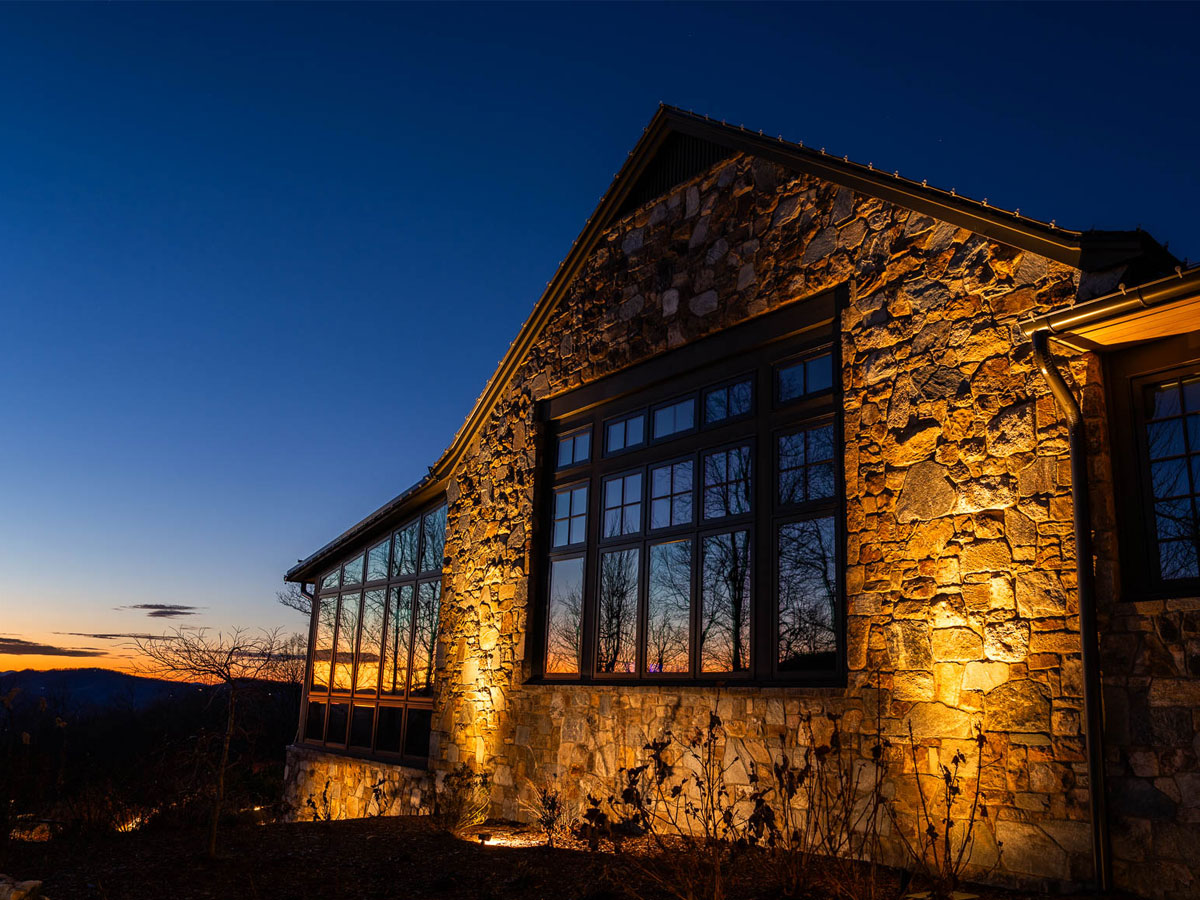
Stone also rewards good lighting. Light placed close and aimed along a wall or the face of the steps brings out every edge and shadow in the stone, so the stairs become a feature at night rather than a dark gap between levels.

How should paths on a hillside be lit?
Path lighting should guide you from one place to the next: the driveway to the door, the patio to the yard, the house to a garden or fire pit. Light the turns, the forks and anywhere the path changes level. Lights on steps and along walkways should show the ground clearly without glaring into anyone’s eyes.
On wooded lots, downlighting from trees can also help. Fixtures mounted high in a tree and aimed down cast soft light and leaf shadows across a path, a little like moonlight, and light the ground over a wider area than a row of small path lights.
How do you make it safe and still look good?
Safety and looks are not a trade-off when the system is designed as a whole. A lit set of stone steps, an uplit tree beside the driveway and soft light on the facade all work together. As we like to say: light reveals, darkness defines. Leaving some areas dark is what makes the lit areas stand out.
Our process is built for this kind of property:
- Consultation: how you use the property and what you want to enjoy more after dark.
- Daytime design walk: the architecture, trees, grade changes and the way the driveway meets the entrance.
- Nighttime placement: we come back after dark with fixtures in hand and place and flag each light in real conditions. On a slope, this is the only way to know how light will fall.
- Materials: commercial-grade fixtures chosen for longevity and consistent light. Brass is our preferred material because it holds its finish and ages well.
- Installation: transformer placement, power runs, trenching and fixture connection, with clean wire runs and no visible conduit.
- Final night walkthrough: we adjust beam angles and placement with you until it looks the way it was designed to look.
What fixtures hold up on mountain properties?
We install commercial-grade, low-voltage LED integrated and modular fixtures built for permanent outdoor installation in Western North Carolina’s climate. These are not hardware-store fixtures. Kits built for a small flat yard tend to fail on a mountain lot in the same ways: thin finishes that corrode, light that is too cool or uneven, and connections that let water in. Read more about landscape lighting for mountain homes.
What maintenance does it need?
Low-voltage LED systems are designed to run reliably with minimal upkeep. On slopes, leaves collect over ground fixtures, plants grow and frost can shift stakes. We recommend an annual maintenance visit to clean fixtures, adjust stake placement and fine-tune any beam angles that have shifted.
Frequently asked questions
Can you add step lighting to the system I already have?
Sometimes. If the existing system was installed with quality fixtures and clean wiring, we can often extend or improve it. We assess everything honestly first. See upgrading existing landscape lighting.
Will driveway lighting bother my neighbors?
It should not if it is designed well. Controlled beams, warm light and careful aiming keep light where it belongs.
Do you light patios and decks at the top of the stairs too?
Yes. Patios, decks, pergolas and outdoor dining areas are part of our patio and outdoor living lighting.
What determines the cost?
Fixture count, wire run lengths, transformer capacity and the complexity of the landscape. Long driveways and many grade changes add to the scope. You receive a detailed quote before any work begins.
Request a landscape lighting quote
See our full process on the landscape lighting page. Spring is our most requested landscape install season. Book your design consultation this winter to get on the calendar. We schedule consultations year round. The design consultation is a paid visit, $135, which includes our time together and your design proposal (or a few options to compare), and the fee goes toward your materials if you move forward.
Call (828) 280-4787 or use the Get A Quote button.
Leave a Reply
Want to join the discussion?Feel free to contribute!