What If a Christmas Light Goes Out? Mid-Season Service in Asheville
If a light goes out after we install it, call us. With Winter Star Lights, service for bulb replacements or any issue caused by our installation is included in your install and takedown fee. Damage from severe weather, animals or property work by others is billed at our standard hourly service rate. Either way, we come back and fix it.
Holiday lights live outside for months in the mountains, through wind, ice and the occasional curious squirrel. Here is how mid-season service works, what usually causes a problem, what to do the moment you notice one and how to keep problems rare.
Is a service call part of my holiday lighting service?
Yes. Our holiday service includes custom design, professional installation, a service call if anything needs attention mid-season, scheduled takedown, cleaning and storage of your materials for the following year. Mid-season service is part of the plan from the start, not something you have to negotiate when a section goes dark in the middle of December.
What changes is who pays for the visit, and that depends only on what caused the problem.
What is covered at no extra charge?
Anything caused by our installation: a bulb that goes out, a run that will not light, a connection that comes loose. That service is already part of your install and takedown fee, so you do not pay again for us to make it right.
The idea is simple. We design the system, supply the lights and install them, so if something we did is the reason it is not working, it is ours to fix.
What is billed separately?
Problems we did not cause are billed at our standard hourly service rate:
- Severe weather: high winds or heavy ice that pull lights down.
- Animals: chewed wires or knocked-down strands.
- Work by others: roofers, painters, gutter cleaners or landscapers who move or damage the lights.
Either way the answer is the same: call us and we come back and fix it.
What are some examples of each?
It helps to see the line drawn on real situations. Here is how common calls sort out under our service terms:
- A bulb goes out on a calm week. Included. Bulb replacements are part of your install and takedown fee.
- A section of roofline will not light the week after install. Included, when the cause is our installation.
- A connection we made comes loose. Included. That is an issue caused by our installation.
- An ice storm pulls a run off the gutter. Billed at our standard hourly service rate, because the cause is severe weather.
- A squirrel chews through a wire in a lit tree. Billed at our standard hourly service rate, because the cause is an animal.
- A gutter cleaner unclips a run and leaves it hanging. Billed at our standard hourly service rate, because the cause is property work by others.
In every one of those cases, we come back and fix it. The only question is whether the visit is already covered or billed hourly.
What usually causes a problem in the mountains?
Asheville area homes ask more of holiday lights than homes in flatter, milder places. These are the situations homeowners here most often run into:
- Wind on ridges and open slopes. Homes on a ridge or at the top of a cove take the full force of winter wind. A strong storm can pull at anything on the roofline or in the trees.
- Ice and snow load. Ice can build up on gutters and eaves, especially on the shaded, north-facing side of a house, and heavy ice is one of the ways lights get pulled down.
- Wildlife. Squirrels and other animals are part of life on a wooded lot. Chewed wires and knocked-down strands are common enough that they are named in our service terms.
- Falling limbs. Mature trees close to a house are beautiful, and winter weather can bring branches down onto lit trees, rooflines or pathways.
- Other work on the house. Gutter cleaning, roof repairs, painting and landscaping all happen in the fall and winter. Anyone working near the lights can move or damage them without meaning to.
Most of these fall under the billed side of the line, because they are not caused by our installation. That is exactly why careful attachment matters so much in the first place.

Why do professional installs have fewer problems?
- Better materials. We use commercial-grade LED lights, custom cut to your home. They are brighter, more energy efficient and longer lasting than retail lights.
- Careful attachment. Every attachment point is chosen deliberately, with tight cord control, so lights stay put through mountain weather.
- Checked every year. At takedown, lights are cleaned and checked before storage, so problems are found in winter, not on install day.
Compare that with a typical do it yourself setup: retail strands bought in different years, extension cords run across the yard, clips that loosen in the cold and lights packed into a box in January without a second look. When something goes out in that setup, you are the repair crew, and you are on a ladder in the cold to find it.
What should I do if a light goes out?
- Do not climb a ladder or roof to fix it yourself. Wet or icy rooflines on a sloped mountain lot are not worth the risk, and our crew is skilled in using safety equipment for exactly this kind of work.
- Take a quick photo if you can, so we can see which section is affected.
- Note what you know. Did it happen after a windy night? Was a roofer or gutter cleaner at the house this week? Did you see an animal around that area? This helps us understand the cause.
- Call (828) 280-4787 and we will schedule a visit.
What can I check safely from the ground?
Some issues are not repairs at all. Before you call, it is worth a quick look at a few things you can reach without a ladder:
- The timer or outlet. If a whole area is dark, check whether an exterior outlet is on a wall switch inside that someone turned off.
- A tripped outlet. Outdoor outlets can trip after heavy rain. If you know how to reset yours safely, that may bring the lights back.
- Obvious damage. A strand hanging loose or a limb lying across a run is worth a photo for us.
Anything up high, on the roof or inside the wiring, leave to us.
How can I keep problems rare this season?
- Tell other contractors the lights are there. If you have gutter cleaning, roofing, painting or tree work scheduled, ask them to work around the lights, or call us first so we can talk through timing.
- Keep pets and kids away from cords at ground level. Pathway and tree runs are designed to be tidy, but a curious dog can still find them.
- Do not add your own strands to our runs. We do not work with pre-owned or client-purchased materials, and mixing them in can create the very problems you are trying to avoid.
- Call early. A small issue noticed the day it happens is easier to fix than one that has had a week of weather on it.
Why only lights you installed?
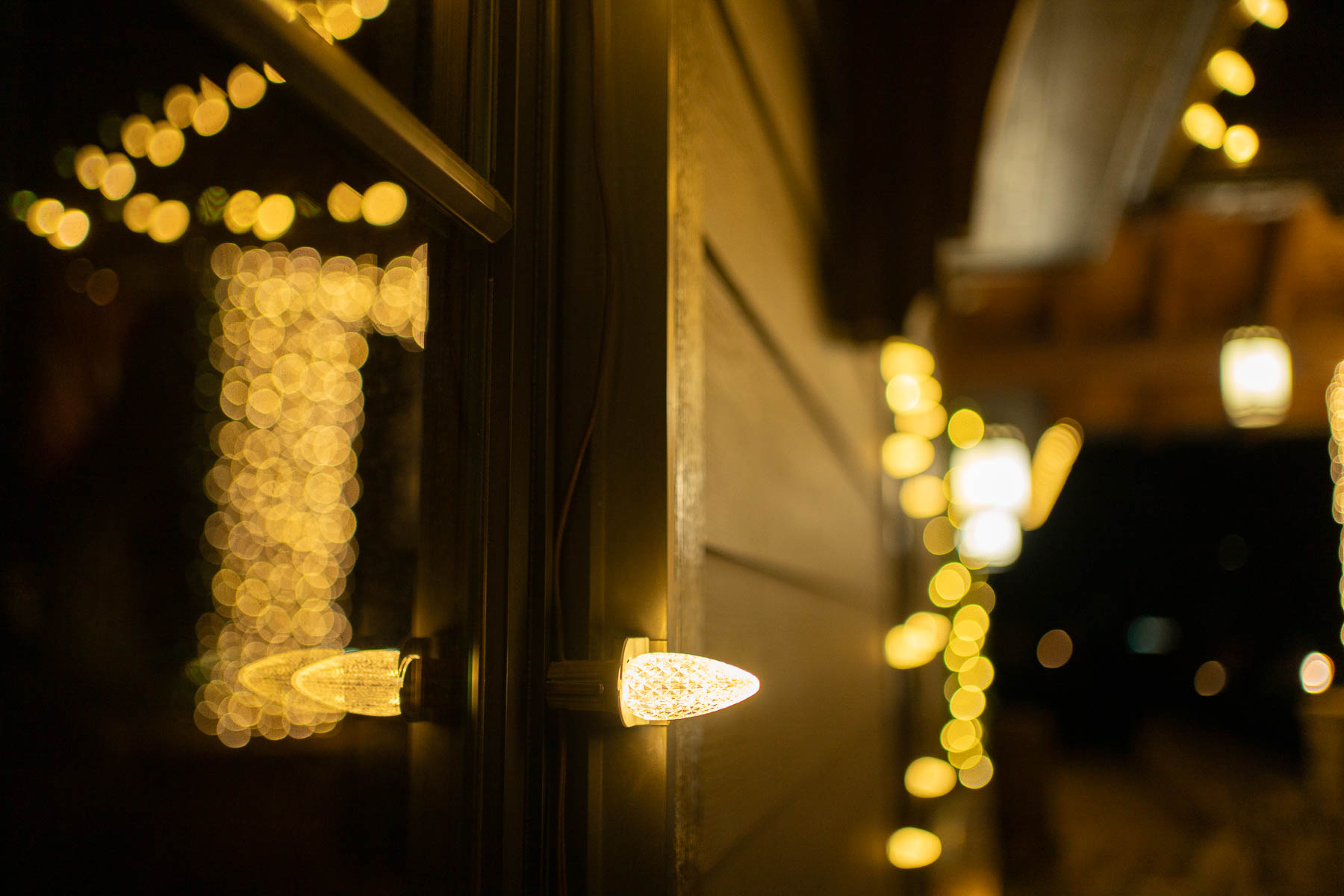
We supply everything we install: commercial-grade LED lights, custom cut to your home’s exact dimensions. They are significantly brighter, more energy efficient and longer lasting than anything available at retail, and you will not find them at a big box store. Because we design the system, supply the materials and install them ourselves, we know exactly what is on your house and how it went up.
That is also why we do not work with pre-owned or client-purchased materials. A mix of store strands, older lights and another company’s work has more weak points and no clear history. When everything on the house is ours, a service call is simpler, and the line between what is included and what is billed is clear.
Is mid-season service the same as a do it yourself fix?
Not really. A do it yourself fix usually means a trip to the store, a ladder in the cold, guessing which bulb or connection failed and hoping the replacement matches. A service call means our crew, who installed the lights, comes back with matching materials and the right safety equipment, finds the problem and fixes it. Your part is a phone call and, if you can, a photo.
What happens at takedown?
Takedown is scheduled between January 1 and February 15. We remove everything with care, then clean and store your lights for next year. That yearly check is a big part of why problems stay rare. Lights are cleaned and checked before storage, so issues are found in winter, not on install day. Read how takedown and storage work for the full process.
Does mid-season service work the same for businesses?
Commercial holiday lighting is quoted separately based on scope, so the details of your service are part of that conversation. See our commercial Christmas lighting guide for how business projects work.
What should I ask a lighting company about repairs?
- Is a mid-season service call included? Get the answer before the season, not when a section goes dark.
- What is covered, and what is billed? Ask for the line in plain words, the way ours is written at the top of this page.
- Who supplies the lights? Commercial-grade materials cut to your home have fewer weak points than retail strands.
- Are you insured? Repairs happen on ladders and rooflines too. Never let an uninsured company or person do this work on your property.
- Do you check the lights at takedown? Cleaning and checking before storage is how problems get caught early.
Frequently asked questions
Do you repair lights from another company or from a store?
No. We supply everything we install and do not work with pre-owned or client-purchased materials.
Are LED lights really more reliable?
Our commercial-grade LED lights last longer and use less energy than retail lights. See LED vs incandescent Christmas lights.
Who decides whether a problem is covered?
It comes down to the cause. Bulb replacements or any issue caused by our installation are included in your install and takedown fee. Damage from severe weather, animals or property work by others is billed at our standard hourly service rate.
Will you still come out if the damage was from a storm?
Yes. Either way, we come back and fix it. Storm damage is billed at our standard hourly service rate.
Is your crew insured?
Yes. Winter Star Holiday Lights is fully insured.
See everything our holiday service includes on the holiday lighting page. New clients start with a paid design consultation at your home, $135, which includes our time together and your design proposal (or a few options to compare), and the fee goes toward your materials if you move forward. Call (828) 280-4787 to book yours.