Commercial Christmas Lighting for Asheville Businesses
Asheville businesses that want professional Christmas lighting should start planning in spring or summer, decide who approves the design, and get a site-specific quote, because commercial displays are priced by scope and the best install dates fill months ahead. The right display fits the building and the brand, reads clearly from the street, and is installed, serviced and removed without disrupting customers.
A lit storefront on a dark December evening does real work for a business. It signals that you are open, makes the building easy to find, and gives people a reason to stop. In a city where the holiday season brings visitors downtown and along the main corridors, a building that glows stands out from the one next door that does not. Here is how to plan it so it actually happens on time and looks the way you want, from the first budget conversation to takedown in the new year.

When should a business start planning holiday lighting?
Earlier than you think. At Winter Star Lights we start planning each season in February, our holiday calendar books out months in advance, and installations begin October 1, with greenery after November 1. Commercial projects tend to need extra lead time for approvals, budgets and access planning.
| Timing | What to do |
|---|---|
| Spring | Decide on goals and budget range, identify who approves the design |
| Summer | Site consultation, design and quote, landlord or board approval |
| Early fall | Confirm install dates and access details |
| October to November | Installation, greenery after November 1 |
| January to mid-February | Takedown |
The reason to start early is simple: commercial projects have more people involved. A homeowner can decide over dinner. A business may need sign-off from an owner, a landlord, a marketing lead or a board, and each of those steps takes time. Budgets are often set for the year well before the holidays, so a display that is not in the budget by summer can be hard to fund in October. Starting in spring gives every step room to happen without a rush. For more on timing, see when to book Christmas light installation in Asheville.
What decides how much commercial holiday lighting costs?
Commercial lighting is quoted separately based on scope. The main factors are:
- Size and height of the building. Long rooflines, multiple stories and tall facades take more material, more time and more equipment.
- What you light. Rooflines, windows, entrances, trees, signage, parking lot islands and patios each add to the scope.
- Greenery and decor. Wreaths and garland on a facade can make a big impact and are part of the overall plan.
- Access. Parking lots in use, busy sidewalks, restricted work hours and shared buildings all affect how the crew works safely.
For a deeper look at the cost factors, our post on what drives the cost of Christmas light installation applies to commercial buildings too.
The most useful thing you can do before a quote is decide what matters most. If the goal is to be found at night, the roofline and the sign may be the priority. If the goal is to welcome customers, the entrance and greenery may matter more than height. A clear priority helps the design put the budget where it does the most work, instead of spreading it thinly across the whole building.
How should a business design its holiday display?
Start with how people see the building
A downtown storefront is seen up close by people on foot. A business on a busy road is seen from a moving car. A building visible from the interstate is seen from far away. Each one calls for a different design. Fine detail is wasted at a distance, and a single bold roofline is wasted on a sidewalk.
Western North Carolina adds its own twist. Many commercial buildings here sit on sloped lots, below or above the road, or at the top of a hill with a parking lot falling away in front. A building seen from below needs its strongest lines at the top. A building that sits below the road may be seen mostly as a roofline, so the roof edge carries the display. Walking the site and looking at it the way customers will see it is the first step in our design process.
Match the tone of the business
A fine dining restaurant, a family retail shop, a law office and a car dealership should not look the same. Warm white and greenery read as elegant and timeless. Color reads as festive and playful. Most businesses do best with one clear idea, executed cleanly.
Light the entrance
Whatever else you do, make the door obvious and welcoming. Wreaths, lit columns or garland around the entrance tell customers exactly where to go.
Think about the trees and the grounds
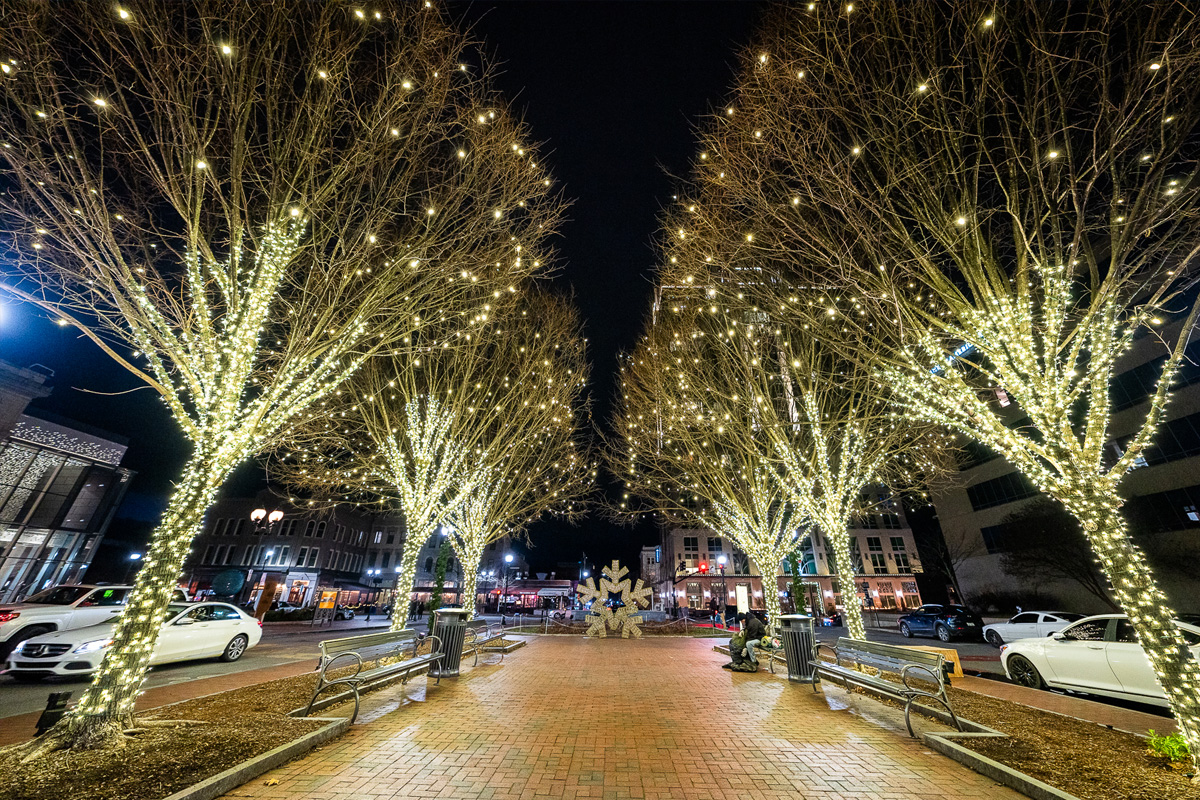
Mature trees in front of a building, landscaped islands in a parking lot and plazas or patios can carry a display on their own. Wrapped trees are especially effective for businesses set back from the road, because they reach out toward the street and draw the eye in. Our work on the trees in Pack Square Park shows how much trees can do for a public space.
Who should be involved in the decision?
Commercial lighting often stalls because nobody knows who has the final say. Before the consultation, identify:
- The owner or manager who sets the goals and budget.
- The landlord or property manager, if you lease, who may need to approve anything attached to the building.
- A board, for HOAs, associations and some nonprofits.
- One point of contact for scheduling and access on install and takedown days.
If you lease, ask your landlord early what can be attached to the building and how. Some leases restrict changes to the facade, and some property managers want to know who will be on the roof. If you are an HOA or community association, our post on HOA rules and holiday lighting covers how boards usually handle approvals.
How does a commercial project work, step by step?
- First conversation. Share the address, what kind of business it is, what you want the display to do and who approves it.
- On-site design consultation. We walk the property, study the architecture and the way customers see and approach the building, and note power, access and anything that affects the crew.
- Design proposal. You get a design proposal, or a few options to compare, built around your building and goals.
- Approval. You take it to the owner, landlord or board as needed.
- Scheduling. Installs begin October 1, with greenery after November 1. We build our schedule by area and will notify you of your date range by phone, text or email.
- Installation. Our crew handles rooflines, trees, pathways and wreaths, with clean lines and careful cord control, and leaves the property clean.
- The season. If something needs attention, call us and we come back.
- Takedown and storage. Between January 1 and February 15 we remove everything, then clean and store your materials for next year. See how takedown and storage work.
What makes a commercial install go smoothly?
Most of the friction on commercial jobs comes from small details nobody mentioned. Before install day, share where the crew can park, which entrances customers use, any hours when work near the door would get in the way, and who to call if something comes up. If the building has shared walls, tenants upstairs or a landlord’s maintenance team, let us know so the plan accounts for them. Locate outdoor power early, because where power is available shapes the design. A clear point of contact and good access notes are often the difference between a quick, quiet install and a complicated one.
Safety matters more on a commercial site than at a home, because customers and staff are moving around the work area. Our crew works on ladders and rooflines throughout the season and is skilled in safety equipment use. Read more about how we approach it in roofline Christmas light safety, and see what to expect on installation day.
What about service during the season?
If something we installed needs attention during the season, call us and we come back. Issues caused by our installation are covered. Damage from severe weather, animals or work by other contractors is billed at our standard hourly service rate. For a business, quick service matters, because a dark section of roofline is visible to every customer. Read more about mid-season repair and service.
A few habits help between visits. Let your staff know who to call if something looks wrong. Ask contractors working on the building in December to keep clear of the lights, since damage from property work by others is billed separately. And after a hard wind or ice storm, take a quick look at the roofline from the parking lot so any issue is reported early.
What should a business ask a holiday lighting company?
- Have you lit commercial properties? We work with restaurants, retail businesses, office buildings, HOAs and community spaces throughout Western North Carolina.
- Who supplies the lights? We supply commercial-grade LED lights custom cut to fit the building.
- What is included? Ask whether design, installation, mid-season service, takedown and storage are all part of the price.
- How will you work around customers? Ask about parking, access and timing.
- How will we know our install date? You want a date range in advance.
- Are you insured? Many landlords will ask. Winter Star Lights is fully insured.
Some businesses also ask about year-round options, and we offer OMNI permanent lighting for commercial buildings.
Frequently asked questions
What types of businesses do you light?
Restaurants, retail businesses, office buildings, HOAs and community spaces throughout Western North Carolina.
How is commercial holiday lighting priced?
Commercial projects are quoted separately based on scope: building size and height, what is lit, greenery and access.
How early should a business book?
Spring or summer is ideal. The calendar books months ahead, and October and November install dates fill first.
Do we need to be on site for installation?
Not necessarily. We need access instructions and a point of contact in advance, plus any notes about customer entrances, parking and busy hours.
When will our lights come down?
Takedown is scheduled between January 1 and February 15. We will let you know your date range ahead of time.
Are you insured for commercial work?
Yes. Winter Star Lights is fully insured, and our crew is trained in ladder and roofline safety equipment.
Start planning your commercial holiday lighting
See our full holiday lighting service, or request a quote online. Every project starts with a paid on-site design consultation, $135, which includes our time together and your design proposal (or a few options to compare), and the fee goes toward your materials if you move forward.
Call (828) 280-4787 or use the Get A Quote button to start the conversation.