What Size Transformer Do I Need for Landscape Lighting?
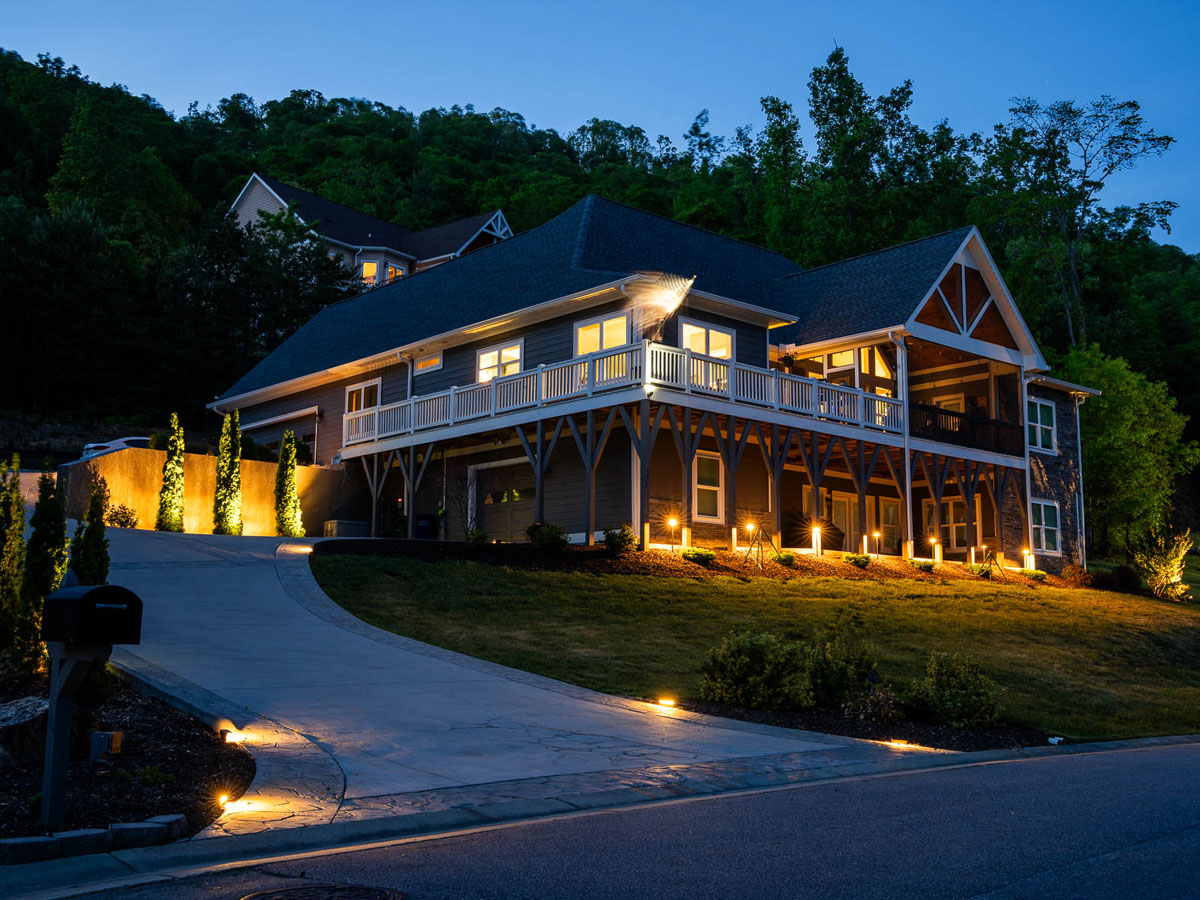
Mountain home with landscape lighting along the driveway, porch and plantings at dusk

A landscape lighting transformer is sized by adding up the wattage of every fixture on it and choosing a unit with comfortable headroom above that total, so it is not running at its limit and has room for fixtures you add later. On larger Western NC lots, wire length and voltage drop matter as much as wattage. Where the transformer sits and how the wire runs are planned together.

What the transformer actually does

Low voltage landscape lighting runs on a transformer that steps household power down to a safe low voltage for outdoor fixtures. It usually mounts on the outside of the house or a post near a GFCI outlet, and wire runs from it out to the fixtures. It is also where the timer or photocell lives, so it controls when the lights come on and off.

Because everything depends on it, an undersized or poorly placed transformer causes most of the problems people blame on fixtures: dim lights at the end of a run, flickering, or a system that trips when another fixture is added.

Adding up the wattage

Every LED fixture has a rated wattage, and many integrated fixtures are adjustable. Add the wattage of all fixtures planned on the transformer to get the load. Then choose a transformer rated comfortably above that load rather than right at it. That headroom keeps the transformer from working at its limit and leaves space for the tree you plant next year or the path you extend.

LED fixtures draw far less power than old halogen fixtures, so many homes that once needed two or three large transformers can now run on fewer. If you are converting an old halogen system, the transformer may still be usable, but it should be checked.

Why long wire runs change the math

Low voltage power loses strength over distance. On a large lot with a long driveway, a lower terrace or a far tree line, the fixtures at the end of a long run can look dimmer than those near the transformer. This is called voltage drop. Heavier gauge wire, splitting the load into several shorter runs, and multi tap transformers that can send a higher voltage out on longer runs all help.

Many properties around Arden and the rest of Western NC have exactly this problem: the house sits at the top of a slope and the lighting reaches down to the road. Planning wire layout and transformer size together is how the whole property ends up evenly lit.

Where the transformer goes

Transformers are placed close to power and close to the center of the lighting layout when possible, and out of sight behind shrubs or on a side wall. On bigger properties, it can make sense to use more than one transformer in different areas rather than running very long wires from a single unit. Transformer placement, power runs and trenching are all part of the installation on our landscape lighting projects.

Timers, photocells and zones

Most homeowners want lights to come on at dusk and turn off at a set time. A photocell senses darkness, and an astronomical timer follows sunset times through the year, which is handy in the mountains where the sun drops behind ridges early. Splitting lights into zones lets the driveway and paths stay on later than the accent lighting on trees and the house.

Expanding an existing system

If you plan to add fixtures to a system someone else installed, check the transformer’s rating and current load first. Our post on upgrading an existing landscape lighting system covers what we look for when deciding whether to extend a system or start fresh.

Frequently asked questions

How do I calculate transformer size?

Add the wattage of all fixtures on the transformer, then choose a unit rated comfortably above that total for headroom.

Why are the lights at the end of my run dim?

Usually voltage drop from a long run or thin wire. Heavier wire, shorter runs or a multi tap transformer can fix it.

Can I use one transformer for a large property?

Sometimes, but large or spread out properties often work better with two or more transformers placed closer to each lit area.

Do LED fixtures need a different transformer?

They use the same low voltage transformers but draw much less power, so a smaller unit or fewer units may be enough.

Who installs landscape lighting transformers in Arden, NC?

Winter Star Lights designs and installs low voltage landscape lighting systems in Arden and Western NC. Call (828) 280-4787 to request a consultation.

Get a free estimate in Arden, NC

Call (828) 280-4787, see the service, or request a free estimate.
Should Patio Lights Be Warm White or Cool White?

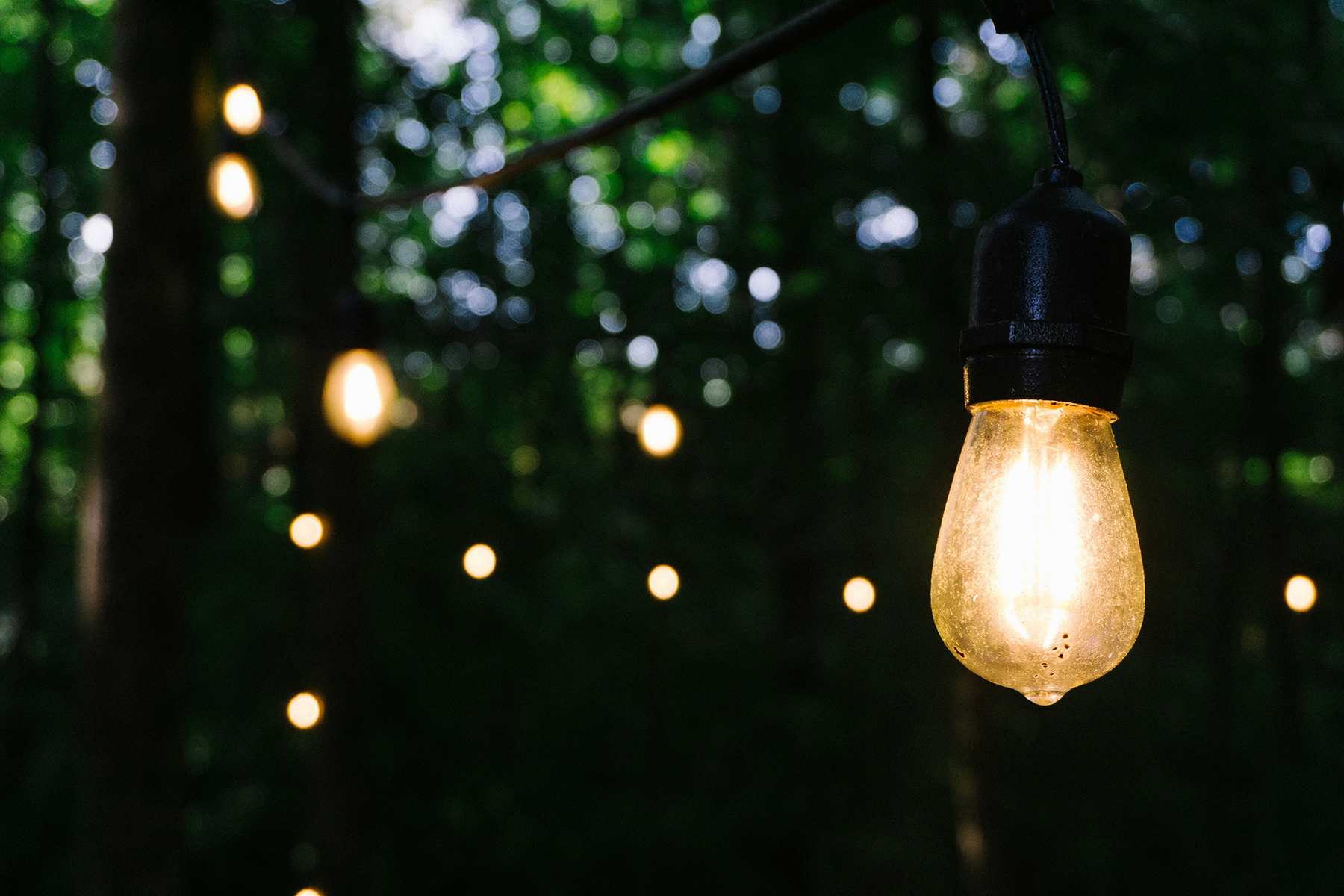
Warm white bistro bulbs glowing on a string over a wooded backyard at dusk

For most patios, porches and outdoor dining areas, warm white is the better fit. It feels relaxed, flatters skin, food and natural materials, and matches the glow of classic bistro bulbs. Cool white is better suited to task areas like a grill station or work space, and programmable color lighting lets you change the mood for events.

What warm and cool white mean

White light is described by color temperature, measured in kelvin. Lower numbers, roughly around 2200K to 2700K, give a warm, golden glow similar to candlelight or an old incandescent bulb. Around 3000K is a soft, neutral warm white. Higher numbers such as 4000K and up look cool, crisp and slightly blue, more like a store or office.

Outdoors at night, the difference is easy to feel. Warm light makes a space feel like somewhere to linger. Cool light makes it feel like somewhere to get something done.

Color temperature is only part of the story. Two warm white bulbs at the same kelvin can still look different if one is much brighter or has a bare, glaring filament. That is why bulb style, brightness and placement are chosen together rather than by number alone.

Why warm white suits Western NC patios

Many outdoor spaces in the mountains are built with wood, stone and lots of plants, and they sit at the edge of dark woods. Warm light brings out the color in wood and stone and blends with the trees instead of fighting them. It flatters people at the table and makes food look good, which matters on a dining patio.

Warm white bistro lighting is one of the main options on our patio and outdoor living lighting projects. Our post on patio string lights installed to last covers how string light systems are hung and supported.

Warm light also suits the way mountain evenings feel. When the air cools down and the woods go quiet, a golden glow over the table and seating area makes the space feel sheltered and inviting rather than exposed.

Where cooler light makes sense

A grill station, an outdoor kitchen prep counter or a workshop door can benefit from a cooler, brighter task light, because it shows true color and detail. The trick is to keep task light focused on that small area, so it does not wash over the seating and dining space. Mixing several color temperatures across one patio usually looks uneven, so most designs keep the main space consistent.

Outdoor kitchens are a good example. Focused warm or neutral lights over the counter can show enough detail for cooking, while bistro strings over the dining table keep the overall feel warm. The two can sit on separate zones so each is turned up or down on its own.

Dimming and color changing options

Brightness matters as much as color. A dimmable, zone controlled system lets you go from full light for setting up a party to a low glow for a quiet evening by the fire pit. Smart controls and dimmers can be set from your phone, so the mood is easy to change.

For people who want more than one look, programmable Omni patio lighting adds color changes at the press of a button. Warm white can be the everyday setting, with color saved for parties, holidays or game nights.

Bugs, rain and mountain weather

Many people find that warmer, yellower light draws fewer insects than cool, blue white light, which is a bonus on summer evenings in Western NC. Whatever color you choose, the fixtures and attachments need to handle rain, humidity and winter weather. Long lasting, weatherproof fixtures and marine grade stainless steel hardware help, along with a yearly check to clean bulbs, check attachments and tighten turnbuckles.

Covered porches and pergolas have their own considerations. Our post on porch, pergola and deck lighting goes through those spaces.

Installation time is usually short. Most patio lighting projects are finished in a single day, with larger or more complex spaces taking two, and existing structures like pergolas and fences are used wherever possible before setting new posts.

Frequently asked questions

What color temperature is warm white?

Roughly 2200K to 3000K. The lower the number, the more golden and candle like the light looks.

Is cool white bad for a patio?

Not bad, but it tends to feel harsh in seating areas. It works better as focused task light at a grill or work area.

Can patio lights change color?

Yes. Programmable Omni patio lighting can switch between warm white and colors for events.

Can I dim my patio lights from my phone?

Yes. Smart control and dimmer options are available and are discussed during the consultation.

Who installs patio lighting in Waynesville, NC?

Winter Star Lights designs and installs patio and outdoor living lighting in Waynesville and Western NC. Call (828) 280-4787 to request a consultation.

Get a free estimate in Waynesville, NC

Call (828) 280-4787, see the service, or request a free estimate.
Can Permanent Roofline Lights Be Used Every Night?

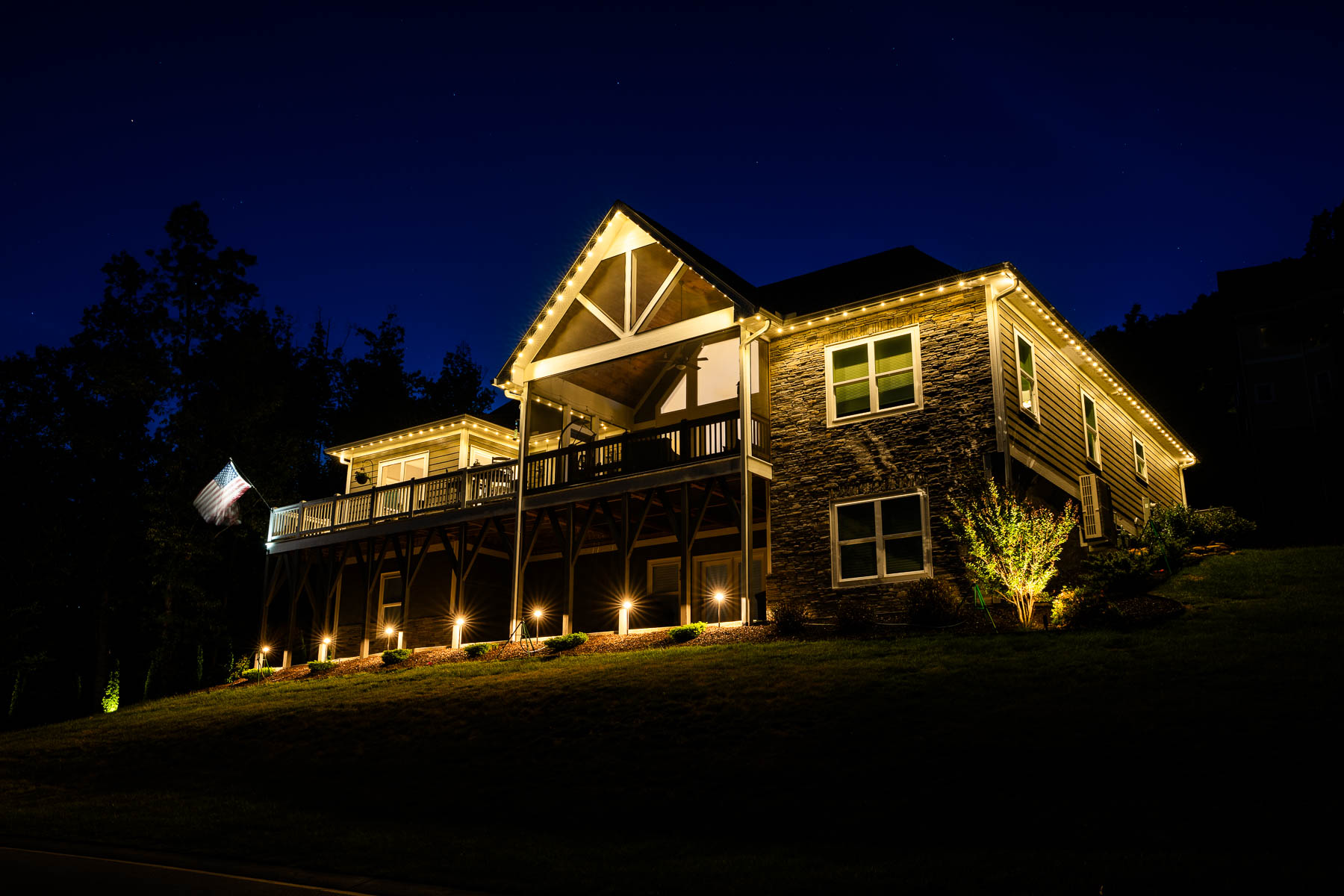
Home with OMNI permanent roofline lighting in warm white installed by Winter Star Lights

Yes. Permanent roofline lighting like OMNI is designed to run every night of the year, not just at the holidays. Most homeowners set it to a soft warm white for everyday architectural light, schedule it to come on at dusk, and switch to color for holidays and celebrations from a phone app.

Everyday light, not just holiday light

Permanent lighting is often thought of as Christmas lights that never come down. In practice, the everyday use is just as valuable. A low, warm white glow along the rooflines outlines the shape of the house, lights the ground around it and makes the home look finished after dark, every night of the year.

Because each bulb is individually controlled, everyday light does not have to mean every bulb on at full brightness. Spacing, brightness and which runs are lit can all be set to suit the house. Our permanent lighting page describes it as refined warm white every evening and full color whenever there is something to celebrate.

It also changes how often you think about outdoor lights at all. There are no ladders each fall and no boxes of tangled strands each January. The lights are simply part of the house, and the app decides what they do each night.

Schedules, timers and scenes

The system is controlled through an app on your phone, with schedules, timers, scenes and dimming built in. A common setup is warm white that turns on around sunset and off at a set time late in the evening, with holiday scenes scheduled ahead for the dates you want them. Before installation is finished, the scenes, schedules and holiday presets are set up, and you are shown how to change them.

In mountain towns like Black Mountain, where ridges can bring dusk early in some seasons, being able to adjust the on time easily is part of what makes everyday use practical.

Practical benefits around the house

Roofline light falls on walkways, porch steps and the driveway apron, which helps on dark evenings, especially on sloped lots with stone steps and uneven ground. It also means the house is not sitting completely dark when you come home late or are away. It does not replace path lighting or dedicated landscape lighting, but it adds a useful layer of soft light.

Paired with landscape lighting on trees, stone and paths, the roofline adds structure from above while the landscape lighting adds depth below.

What it looks like during the day

A common concern with everyday lighting is how the hardware looks in daylight. OMNI fixtures are low profile and tucked into the roofline in a color matched track, with hidden wiring, so most people never notice them until the lights come on. That matters more for a system that stays up permanently than for seasonal lights that come down in January.

Track color is matched to your trim during the design consultation, when the rooflines, gables and details worth lighting are mapped and you see the plan and exact price before anything is installed.

Weather in the mountains

Lights that stay up all year have to handle Western NC weather: snow, ice, wind storms, heavy rain and summer heat. The fixtures are fully weather rated for year round outdoor use. As with any outdoor system, an occasional check of the track and connections is sensible after a severe storm.

Holidays and everything in between

The same system that runs warm white on a Tuesday can show red and green in December, orange for Halloween, red, white and blue for the Fourth of July or team colors on game day. Our post on what OMNI permanent lights can do goes through more of those options, and permanent vs seasonal Christmas lights compares permanent lighting with seasonal installs.

Frequently asked questions

Can permanent lights be set to plain white?

Yes. Most homeowners run soft warm white every evening and switch to color for holidays and events.

Can I schedule permanent lights to come on at dusk?

Yes. The app includes schedules, timers, scenes and dimming, and the schedules are set up before installation is finished.

Are permanent roofline lights visible during the day?

Barely, if at all. The fixtures are low profile and sit in a color matched track tucked into the roofline.

Will permanent lights hold up to mountain winters?

The fixtures are fully weather rated for year round use through snow, ice, storms and summer heat.

Who installs permanent roofline lighting in Black Mountain, NC?

Winter Star Lights designs and installs OMNI permanent lighting in Black Mountain and Western NC. Call (828) 280-4787 to request a consultation.

Get a free estimate in Black Mountain, NC

Call (828) 280-4787, see the service, or request a free estimate.
Will Landscape Lighting Ruin My Mountain View at Night?

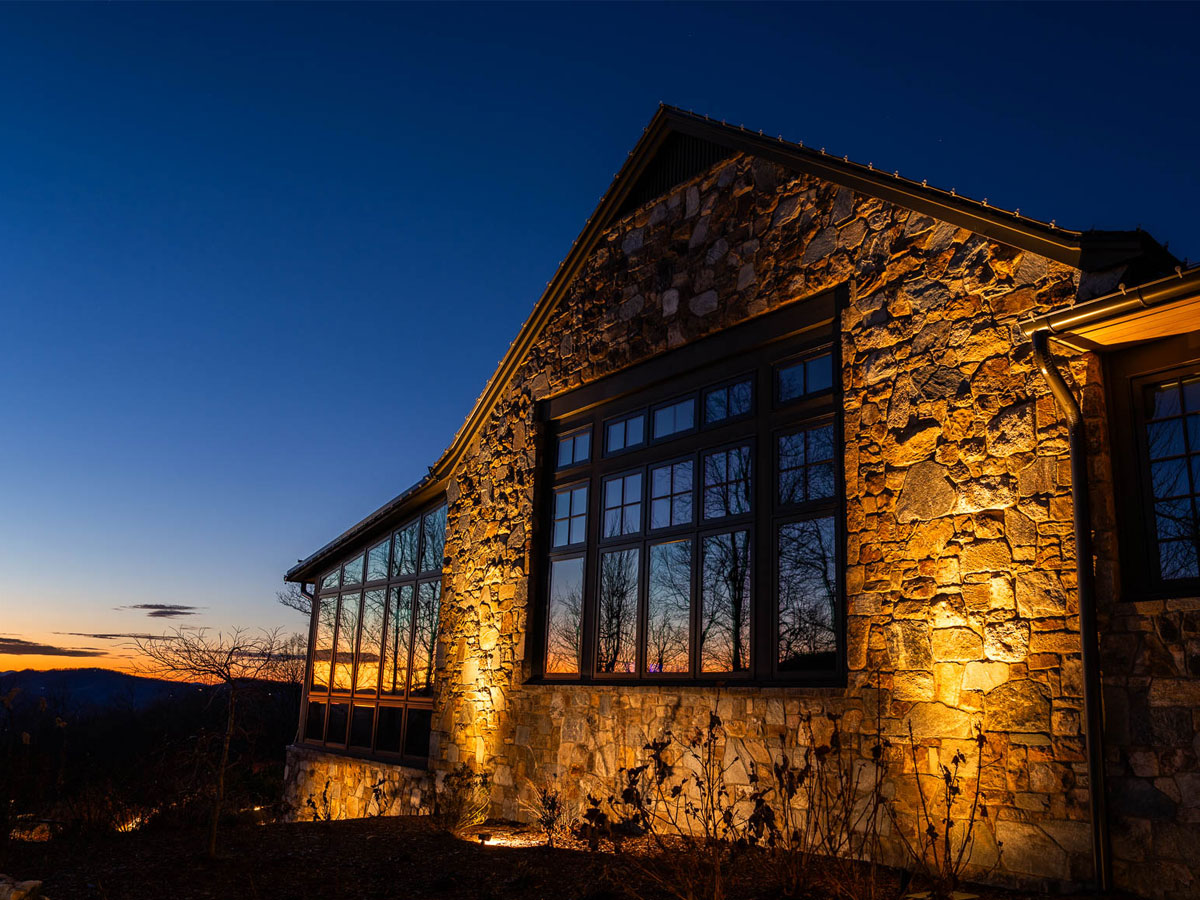
Stone mountain home softly uplit at dusk with a sunset over the ridges behind it

Landscape lighting does not have to ruin a mountain view, but poorly aimed or overly bright lights can. The keys are controlling glare, keeping light low and pointed where it is needed, choosing warm color, and keeping the side of the property facing the view darker. Done well, you see the lit garden near the house and still see the ridgeline and stars beyond it.

Why some outdoor lights block the view

The view at night is lost for two main reasons. The first is glare: bright, exposed light sources in your line of sight make your eyes adjust to them, and the darker distance disappears. The second is reflection: lights near big windows bounce back off the glass, so from inside you see your own reflection and bright spots instead of the mountains.

Floodlights on the corners of a house cause both problems at once. They light everything evenly, spill out toward the view and shine straight into the eyes of anyone on the deck.

Security lights with motion sensors are another common culprit. They snap on at full brightness when a deer walks through the yard and leave everyone blinking. Soft landscape lighting that is already on at a low level often feels safer and does not jolt the whole hillside awake.

Keep light low, shielded and aimed

Fixtures with shields and the right beam angle put light only where it belongs: on a stone wall, a tree, steps or a planting bed. Path and step lights that throw light down keep the ground lit without lighting the air. On a view side deck, low fixtures that wash the floor or the stairs let you move safely while your eyes stay adjusted to the dark beyond.

Our landscape lighting designs build around what the property already does well, including the trees, the stone and the lines of the architecture. On a view property, the view itself is one of those things, and the design leaves room for it.

Warm color and dimming help

Warm white light looks natural against stone and wood and feels calmer at night than cool, blue white light. It also tends to blend into the landscape instead of standing out from miles away. Dimming lets you set each zone just bright enough. A softly lit house and garden often look more dramatic than a brightly lit one, because the contrast with the dark mountains is part of the effect.

It also helps to light objects rather than open space. A softly uplit tree or stone wall near the house gives the eye a focal point, while an open lawn or slope left dark keeps the line of sight to the mountains clear.

Mind the windows

From inside, the biggest enemy of a night view is light near the glass. Avoid aiming fixtures at large windows, keep the lighting nearest the view windows low and soft, and turn interior lights down when you want to look out. Lighting the landscape a bit farther from the house can actually help, because it gives your eye something to look at outside rather than a reflection.

Placement is tested during a nighttime visit before installation, which is the stage where glare and reflection problems are easiest to see and fix.

Neighbors and the night sky

In the hills around Hendersonville and the rest of Western NC, homes look across valleys at each other. Light that spills upward or outward can be seen from far away. Shielded fixtures, careful aim and timers that turn accent lighting off later in the evening keep your property lit for you without shining into a neighbor’s view or washing out the stars.

Our post on landscape lighting for mountain homes covers other ways steep sites, stone and long driveways shape a design.

Frequently asked questions

Will lights reflect in my view windows?

They can if fixtures are near or aimed at the glass. Keeping lights low and soft near view windows reduces reflections.

What color light is easiest on the night sky?

Warm white light blends better with stone and wood and stands out less from a distance than cool white light.

Can I turn off some lights later at night?

Yes. Splitting lighting into zones on timers lets accent lighting turn off while path and driveway lighting stays on.

Is it better to light less on a view property?

Usually less but better placed. Soft light near the house with darkness toward the view keeps the ridgeline visible.

Who designs view friendly landscape lighting in Hendersonville, NC?

Winter Star Lights designs and installs landscape lighting in Hendersonville and Western NC. Call (828) 280-4787 to request a consultation.

Get a free estimate in Hendersonville, NC

Call (828) 280-4787, see the service, or request a free estimate.
How Do You Uplight a Large Tree?

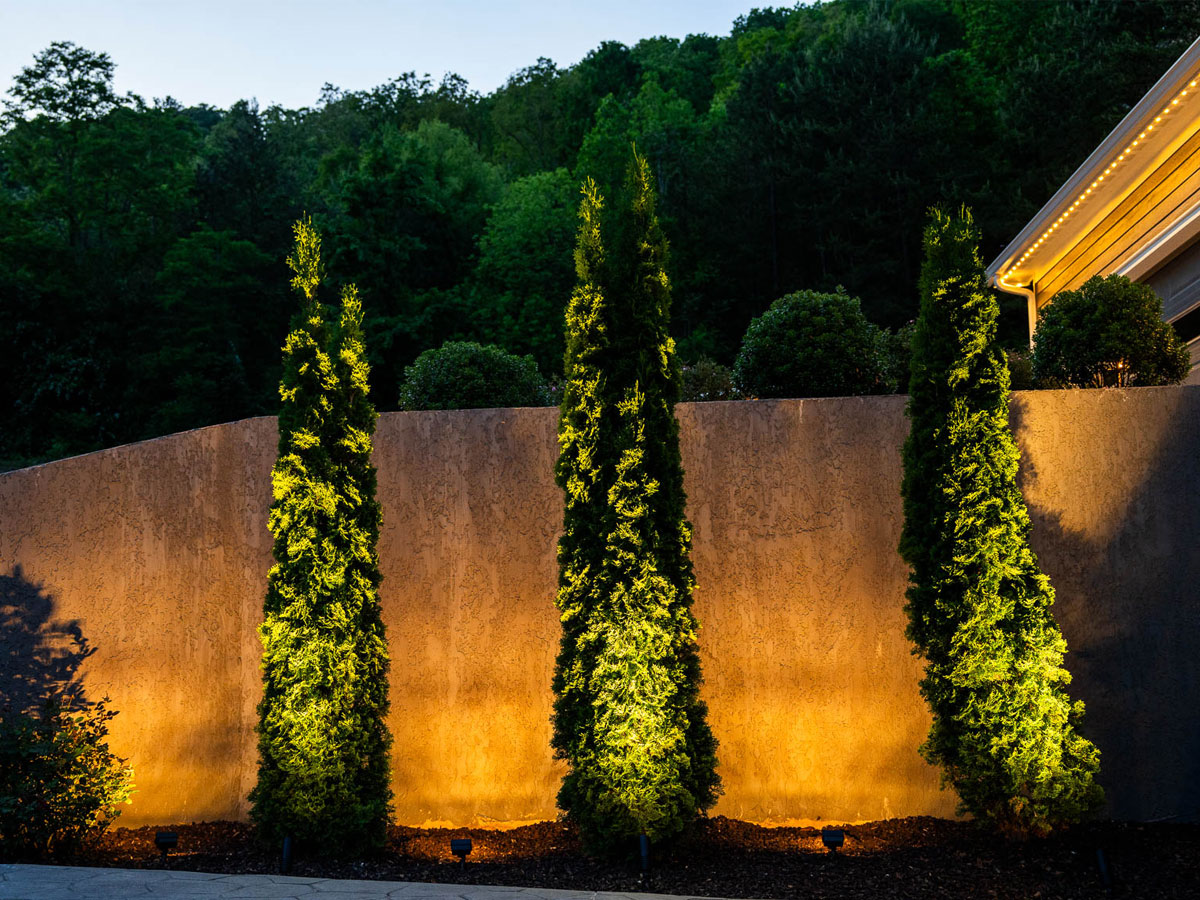
Three tall evergreens uplit against a curved wall at dusk, landscape lighting by Winter Star Lights

A large tree is uplit by placing fixtures at its base and aiming them so the light climbs the trunk and fills the canopy. Big trees usually need more than one fixture, set at different distances and beam spreads, so the tree looks full and three dimensional instead of a bright spot at the bottom. The right setup depends on the tree’s shape, height and how it is seen from the house and drive.

Start with how the tree is viewed

Before placing any light, decide where the tree will be seen from at night: the driveway, the front door, a window or the patio. Fixtures go on the viewing side, tucked into beds or ground cover, so the lit face of the tree faces you and the fixture itself is hidden. A tree lit from the wrong side looks like a silhouette.

In and around Weaverville, many homes sit on slopes with trees above or below the house. A tree uphill from the patio is lit differently from one you look down onto from a deck, and that view decides how fixtures are aimed.

Match the beam to the tree's shape

Tall, narrow trees like hemlocks, arborvitae and columnar evergreens usually look right with narrower beams aimed up along their height. Wide, spreading trees like oaks and maples need wider beams, or two or three fixtures, to light the canopy from side to side. Placing fixtures a short distance out from the trunk lets the light reach up into the branches instead of only hitting the bark.

Fixture selection, placement and beam angle are deliberate choices on our landscape lighting projects, not lights stuck in the ground. Brass fixtures are a common choice because they hold up outdoors and keep their finish.

Deciduous trees look different in winter

Western NC has a lot of hardwoods. In summer, uplighting fills the leafy canopy with a soft glow. In winter, the same fixtures show off the bare trunk and branch structure, which can be even more striking. Plan the lighting with both seasons in mind, and make sure the fixtures are not aimed so steeply that light shoots straight through bare branches into the sky.

Evergreens stay consistent all year, which makes them a dependable anchor in a design that also includes hardwoods.

Moonlighting: light from above

For very large trees, some fixtures can be mounted up in the tree and aimed down. This is often called moonlighting. It casts soft, dappled shadows of branches onto lawns, paths and patios below, much like moonlight. Combined with uplighting from the base, it makes a big tree glow from within and lights the ground around it at the same time.

Fixtures mounted in trees need to be installed with care so they do not harm the tree and can be adjusted as it grows.

Protecting roots, fixtures and wildlife

Wire runs near large trees need to work around roots rather than through them. Fixtures near the trunk should be placed where mowers and string trimmers will not hit them. Deer and other wildlife browse through Western NC yards at night, so sturdy fixtures and wire that is buried properly hold up better than lightweight kits sitting on top of the mulch.

Trees also grow every year. An annual maintenance visit to re aim fixtures as branches fill in keeps the tree looking the way it did when it was installed.

Year round and holiday tree lighting

Uplighting is permanent landscape lighting that runs every night. Wrapping trees with lights for the holidays is a separate, seasonal service. Our post on how to light trees and landscaping for the holidays covers the seasonal side.

Frequently asked questions

How many lights does it take to uplight a big tree?

Many large trees need two or three fixtures to light the trunk and canopy evenly. Narrow trees may need only one.

How far from the trunk should an uplight go?

A short distance out from the trunk usually lets light reach the canopy. The exact spot depends on the tree and viewing angle.

Can you uplight a tree in winter with no leaves?

Yes. Bare hardwoods show off their branch structure, which can look dramatic. Aim fixtures so light does not shoot into the sky.

Will uplighting hurt my tree?

Ground fixtures do not harm the tree. Wire is routed around roots, and fixtures mounted in trees are installed with care.

Who uplights trees in Weaverville, NC?

Winter Star Lights designs and installs tree uplighting and landscape lighting in Weaverville and Western NC. Call (828) 280-4787 to request a consultation.

Get a free estimate in Weaverville, NC

Call (828) 280-4787, see the service, or request a free estimate.
How Far Apart Should Path Lights Be?

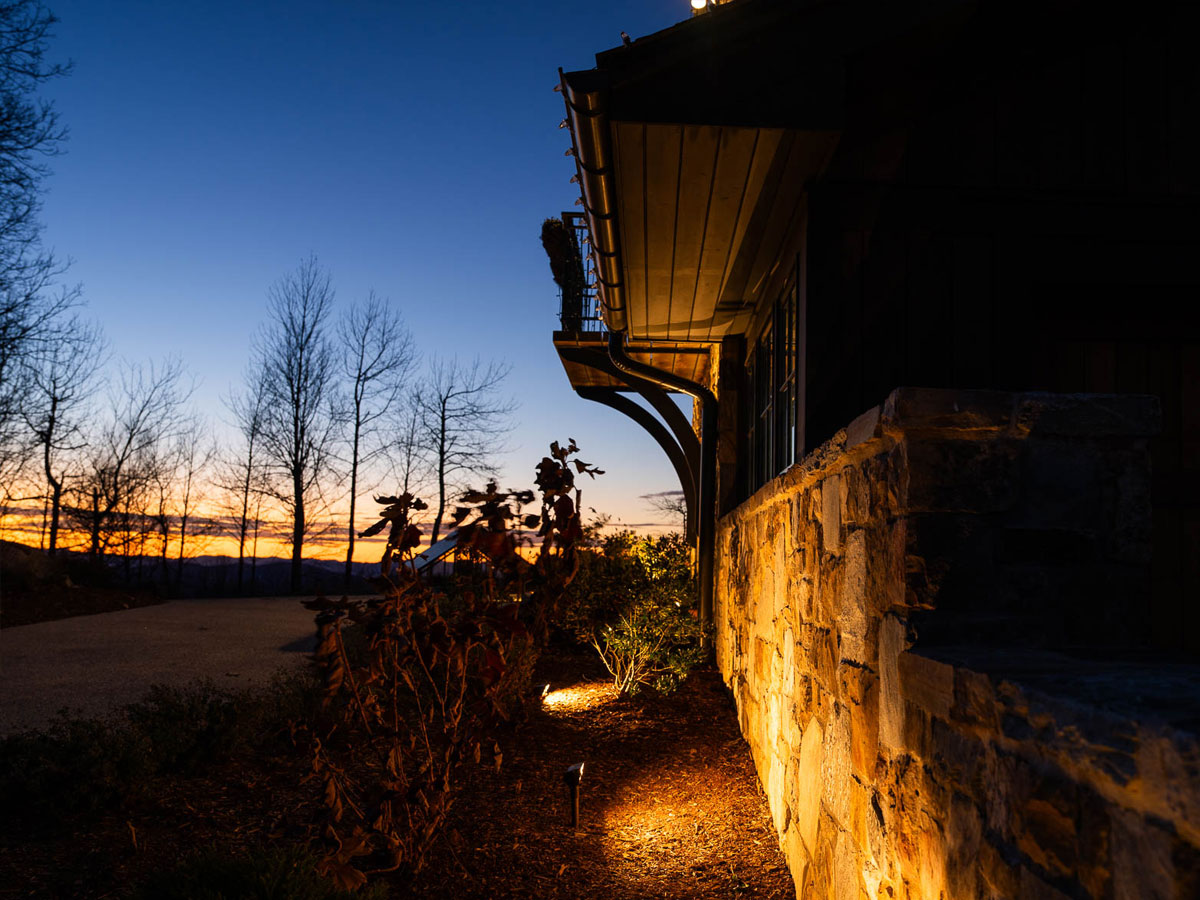
Path light glowing along a stone wall at dusk on a Western NC property, lit by Winter Star Lights

Path lights are usually spaced so their pools of light just meet or slightly overlap on the walking surface, which on many residential paths works out to somewhere around six to ten feet apart. The right spacing depends on the fixture’s output and height, the width of the path and the grade. On sloped Asheville properties, steps, turns and level changes matter more than a fixed distance.

Light the ground, not the fixture

The goal of path lighting is to show where to step. A good path light throws a soft pool of light down onto the walkway and the plantings beside it, while the fixture itself stays low glare and easy to overlook. When fixtures are too bright or too close, the path looks like a runway and your eye goes to the lights instead of the ground.

So spacing starts with the fixture. A taller fixture with a wider spread covers more ground and can be placed farther apart. A short, tightly focused fixture needs to be closer. That is why two paths with different fixtures can both look right at different spacing.

Why a straight line of lights often looks wrong

Placing fixtures in two straight rows on both sides of a path, evenly spaced, is the most common mistake. It looks mechanical in daylight and creates a striped pattern at night. Staggering fixtures from one side of the path to the other, and tucking them into plantings rather than in open lawn, gives a more natural look with fewer fixtures.

Gaps are fine too. A short stretch of darker path between two pools of light still feels safe, as long as there are no dark spots at the places where people actually trip.

Wider paths and driveways change the approach too. A wide walkway may need fixtures on both sides in a loose stagger, while a narrow garden path through a bed can often be lit from one side alone.

Mountain paths: steps, turns and slopes come first

In Western NC, very few paths are flat and straight. Stone steps, switchbacks, roots and changes in grade are where lighting does the most good. Place light at the top and bottom of every set of steps, at turns, at junctions where paths meet the driveway or patio, and anywhere the surface changes from stone to gravel or mulch. Then fill in between as needed.

On stone stairs, low step lights or fixtures that wash light across the treads often work better than tall path lights. Our post on landscape lighting for steep driveways, stone stairs and paths covers those situations in more detail.

Why placement is tested at night

Distances on a plan rarely match how light looks on the ground. Plantings, slope and the color of the stone all change how far light travels. That is why our landscape lighting process includes a nighttime placement visit, where fixtures are set out after dark and flagged exactly where they belong before installation begins.

After installation, a final walkthrough at night is used to fine tune beam angles and stake positions. It is the only reliable way to make sure the pools of light connect the way they should.

Keeping path lights looking right over time

Plants grow, mulch builds up and stakes get bumped by mowers and foot traffic. A light that was perfect at installation can end up buried in a shrub or tilted toward the house. An annual maintenance visit to clean fixtures, adjust stakes and fine tune beam angles keeps the path lit the way it was designed.

If you have an older system with uneven spacing or dead fixtures, it can sometimes be improved rather than replaced. Our post on upgrading an existing landscape lighting system explains how that is assessed.

Frequently asked questions

How many path lights do I need?

It depends on fixture output, path length and grade. Light the steps, turns and junctions first, then fill in so pools of light meet.

Should path lights go on both sides of a walkway?

Not usually in matching rows. Staggering fixtures from side to side looks more natural and often needs fewer lights.

How bright should path lights be?

Bright enough to see the walking surface clearly, but soft enough that the fixture itself does not glare. Low, even light reads better at night.

Do path lights work on steep slopes?

Yes, but placement matters more than spacing. Light the top and bottom of steps and any change in grade.

Who designs path lighting in Asheville, NC?

Winter Star Lights designs and installs path and landscape lighting in Asheville and Western NC. Call (828) 280-4787 to request a consultation.

Get a free estimate in Asheville, NC

Call (828) 280-4787, see the service, or request a free estimate.

How Booking, Deposits and Install Dates Work for Christmas Lights in Asheville

Booking professional Christmas lights in Asheville starts with a paid design consultation at your home. After that you get a custom plan and quote, new clients secure their place with a deposit, and we schedule installs by neighborhood from October 1, giving you a date range ahead of time instead of a specific day. Returning clients reserve their spot in February with a 25% deposit.

If you have never hired a holiday lighting company before, the booking side can feel unclear: when to call, what the deposit covers and why you get a date range. Here is exactly how it works with Winter Star Lights for homes in Asheville, Weaverville, Black Mountain, Hendersonville, Arden and the surrounding towns.

Lit tree and roofline lights on a home in Western North Carolina at night

How do I book Christmas light installation?

Every booking starts with a paid design consultation at your home, $135, which includes our time together and your design proposal (or a few options to compare), and the fee goes toward your materials if you move forward. We visit your home, measure, study the architecture and build your custom plan. From there you get a plan and a clear quote for the property.

How does the deposit work?

New clients secure their place with a deposit. Your quote shows what is included, which items are rentals and how the deposit and balance work, so there are no surprises. For OMNI permanent lighting, new clients secure placement with a 50% deposit, with the balance due on installation day.

How do returning clients book?

We start planning the next holiday season in February, and that is when returning clients come back on the calendar. Returning clients secure their place with a 25% deposit in February, with the balance due October 1. Any upgrades or changes can be discussed between February and September and added to your final invoice.

Why do I get a date range instead of a specific day?

We build our schedule by neighborhood, which keeps the crew efficient. Driving a crew from Weaverville to Arden and back again in one day wastes hours that should be spent on rooflines, and grouping homes that are near each other keeps the crew on your house longer and on the road less. Because of that neighborhood routing we cannot guarantee specific dates, and we always tell you promptly if something changes. You get your date range ahead of time by phone, text or email.

When do installs start and end?

We begin installing October 1, and greenery goes up after November 1 so it stays fresh. October and November install dates fill first, and our calendar books months ahead. Takedown is scheduled between January 1 and February 15. If you want to know the best time to call, read when to book Christmas light installation in Asheville.

What do I need to do before install day?

  • Access: our crew needs gate or door codes and any access notes, and reactive pets secured. You do not need to be home.
  • Long or tight driveways: tell us where a truck should park and whether there is a pull-off at the top or bottom.
  • Other work: if you have gutter cleaning, roofing, painting or tree work scheduled, ask them to work around the lights, or call us first so we can talk through timing.

Our install day guide covers what you will see when the crew arrives.

Frequently asked questions

How much is the design consultation?

$135. It includes our time together and your design proposal (or a few options to compare), and the fee goes toward your materials if you move forward.

Can I pick an exact install date?

No. We schedule by neighborhood, so we give you a date range ahead of time rather than a specific day, and we tell you promptly if anything changes.

When is the balance due for returning clients?

Returning clients pay a 25% deposit in February, with the balance due October 1.

When are permanent lights paid for?

For OMNI permanent lighting, new clients secure placement with a 50% deposit, with the balance due on installation day.

Which towns do you serve?

Asheville and nearby communities including Weaverville, Black Mountain, Hendersonville, Biltmore Park, Arden, Fletcher, Woodfin, Waynesville and Brevard.

Get on the calendar

See everything our holiday service includes on the holiday lighting page.

Call (828) 280-4787 or request your quote.


More outdoor lighting questions

Christmas Light Installation FAQ for Asheville Homeowners

Professional Christmas light installation in Asheville covers the whole season: a custom design, commercial-grade LED lights cut to fit your home, installation from October 1, a service call if anything needs attention, and takedown, cleaning and storage between January 1 and February 15. Packages typically start at $1,500, and every home gets its own quote after a paid design consultation.

Winter Star Lights designs, installs, maintains and takes down Christmas lights for homes across Asheville and the surrounding Western North Carolina communities, including Weaverville, Black Mountain, Hendersonville, Biltmore Park, Arden, Fletcher, Woodfin, Waynesville and Brevard. Here are straight answers to the questions homeowners ask most.

Stone home in Asheville, NC with warm white Christmas lights along the roofline

What does Christmas light installation include?

Our holiday service includes custom design, professional installation, a service call if anything needs attention mid-season, scheduled takedown, cleaning and storage of your materials for the following year. Our crew handles rooflines, gutters, trees, pathways and wreaths. From the first consultation to the final coil in storage, you do not lift a finger. See everything included on our holiday lighting page.

How much does it cost?

Our packages typically start at $1,500, with first-year installs typically falling between $2,500 and $5,000, and repeat years are approximately 75 to 80 percent of the initial investment. Price depends on how many feet of roofline you want lit, how high and steep it is, and how many trees, wreaths and extras you add. Wreaths, garland and mini lights are rental items priced separately. For the full breakdown, read how much Christmas light installation costs in Asheville.

Do you supply the lights?

Yes. We supply all materials, commercial-grade LED lights custom cut to fit your home, and do not work with client-purchased or used lights. The custom perimeter lights cut for your roofline become yours, and we store and reinstall them each year.

When do the lights go up and come down?

We begin installing October 1, and greenery goes up after November 1 so it stays fresh. Takedown is scheduled between January 1 and February 15. We build our schedule by neighborhood, so we give you a date range by phone, text or email rather than a specific day.

Do I need to be home?

No. Our crew needs gate or door codes and any access notes, and reactive pets secured. The crew installs, checks every run and leaves your property clean and lit.

What if a bulb goes out?

Call us and we come back. Service for bulb replacements or any issue caused by our installation is included in your install and takedown fee. Damage from severe weather, animals or property work by others is billed at our standard hourly service rate.

Are you insured?

Yes. Winter Star Holiday Lights is fully insured, and our crew is skilled in using safety equipment on ladders and rooflines. Whoever you hire, ask any company for proof of insurance. Read more about roofline Christmas light safety.

Will installation damage my roof or gutters?

We choose every attachment point deliberately and use proper clips, with clean lines and no damage to your home.

Frequently asked questions

Do you install Christmas lights outside Asheville?

Yes. We serve Asheville and nearby communities including Weaverville, Black Mountain, Hendersonville, Arden, Fletcher, Woodfin, Waynesville and Brevard.

Do returning clients pay less?

Usually. For the same design, repeat years are approximately 75 to 80 percent of the initial investment, because the custom perimeter lights are already yours.

How do returning clients book?

Returning clients secure their place with a 25% deposit in February, with the balance due October 1.

Do you light businesses?

Yes. We work with restaurants, retail businesses, office buildings, HOAs and community spaces throughout Western North Carolina. Commercial projects are quoted separately based on scope.

How do I get a quote?

Every quote starts with a paid design consultation at your home, $135, which includes our time together and your design proposal (or a few options to compare), and the fee goes toward your materials if you move forward.

Call (828) 280-4787 or request your quote.


More outdoor lighting questions

Permanent Holiday Lights in Asheville: Your Questions Answered

Permanent holiday lights are small, low-profile fixtures mounted once in a color-matched track along your roofline and left in place year round. With OMNI, every bulb is controlled from an app on your phone, so the same lights give you soft warm white every evening and full color for Christmas, Halloween, the Fourth of July, game days and birthdays. Most homes are finished in one to two days.

Winter Star Lights installs OMNI permanent lighting on homes and businesses in Asheville, Hendersonville, Weaverville, Black Mountain and across Western North Carolina. These are the questions homeowners ask us most, answered plainly.

OMNI permanent roofline lighting in warm white on a two-story home in Western North Carolina

What is permanent holiday lighting?

Permanent lighting is a set of small, low-profile fixtures mounted in a color-matched track along your roofline and left in place year round. Our team integrates the fixtures into your roofline with color-matched track and hidden wiring. It works as architectural lighting, lighting the facade and the approach to the house, not just as holiday decor.

Can you see permanent lights during the day?

Most people do not notice them until they turn on. OMNI fixtures are low profile and sit in a track color-matched to your trim, whether your eaves are painted white, dark or natural wood. At night it looks like architectural lighting that was part of the house from the start.

Is permanent lighting only for Christmas?

No. Most of our clients run warm white every night and switch to color only for holidays and celebrations. A typical year might look like this: warm white from dusk every night, a Halloween scene for the last week of October, December color for the holiday season, red white and blue around the Fourth of July, and team colors on game days.

How do you control OMNI lights?

Through a simple app on your phone, with schedules, timers, scenes and dimming built in. Each bulb is individually controlled, and both steady and moving options are available. Before we leave, your scenes, schedules and holiday presets are built and running, and we walk you through the app so you know exactly how to change them.

Can permanent lights handle Asheville weather?

Yes. OMNI fixtures are fully weather rated and built to live outside year round, through snow, ice, storms and summer heat. That matters here, where a single winter can bring all of it, and where ridgeline houses take the full force of wind.

How long does a permanent lighting install take?

Most homes are finished in one to two days, and we leave the property cleaner than we found it. On install day our team mounts the fixtures in color-matched track along your roofline, routes the wiring so it stays out of sight, and connects the controller.

How much does permanent lighting cost?

Pricing follows your rooflines, so every home is different. The length of roofline, the number of gables and corners, the height and pitch of the roof and where the controller and power can go all play a part. We measure your home, design the layout and give you an exact number before any work starts. New clients secure placement with a 50% deposit, with the balance due on installation day.

Will my HOA allow permanent lights?

It depends on your covenants. In our experience permanent lighting is widely HOA friendly because the fixtures are discreet and the everyday light is a tasteful warm white, not a year-round Christmas display. We are happy to provide product details for your board. Our guide to HOA rules for holiday and permanent lighting lists the questions worth asking first.

Permanent or seasonal: which is right for me?

In Asheville, permanent lighting usually makes more sense if you want light every evening and never want to schedule an install again, and seasonal lighting makes more sense if you love a classic December look with greenery and wrapped trees. Some clients pair permanent roofline lighting with seasonal wreaths, garland or lit trees for December. We install both, so we have no reason to push you one way. Read permanent vs seasonal Christmas lights for a side by side.

Frequently asked questions

Do OMNI lights come with a warranty?

The work is backed by our workmanship warranty.

Do I still need a ladder for the holidays?

No. Once OMNI is installed, holiday color is a scene on your phone, not a weekend on the roof.

Can I switch from seasonal to permanent later?

Yes. Starting with seasonal service and moving to permanent lighting once you know you want the roofline lit for good is a sensible path.

Do you install OMNI on businesses?

Yes. We have installed OMNI on commercial buildings in Asheville as well as homes.

See if permanent lighting fits your home

Every project starts with a paid design consultation at your home, $135, which includes our time together and your design proposal (or a few options to compare), and the fee goes toward your materials if you move forward. See the full details on our OMNI permanent lighting page.

Call (828) 280-4787 or request your quote.


More outdoor lighting questions

Christmas Lights in Snow, Ice and Wind: What Asheville Homeowners Should Know

Professionally installed Christmas lights are built to handle a normal Western North Carolina winter. Commercial-grade LEDs perform well in the cold, and every attachment point is chosen to keep lights in place through mountain weather. If severe wind, heavy ice or a falling branch pulls lights down, call us and we come back to fix it, billed at our standard hourly service rate.

Holiday lights live outside for months here. Installs start October 1 and takedown runs from January 1 to February 15, so your display sees frost, ice, wind and the occasional snowstorm. Here is what holds up, what can go wrong, and what to do when the weather turns, for homes in Asheville, Weaverville, Black Mountain, Hendersonville and the surrounding towns.

Trees wrapped in warm white holiday lights on a winter night in downtown Asheville, NC

Do Christmas lights work in freezing weather?

Yes. LEDs perform well in cold weather, and with no filament they are less likely to fail when a strand gets bumped by wind or ice. For a roofline that has to survive two to four months of mountain weather, LEDs are the practical choice. We install commercial-grade LED lights, which are typically built with heavier wire and better-sealed sockets than retail strands and are designed to be used season after season.

What does ice do to holiday lights?

Ice can build up on gutters and eaves, especially on the shaded, north-facing side of a house, and heavy ice is one of the ways lights get pulled down. That is why every attachment point is chosen deliberately, with tight cord control, so lights stay put through mountain weather. Lights cut to the exact length of each run also leave no loose loops for ice to weigh down.

Will wind knock my lights down?

Homes on a ridge or at the top of a cove take the full force of winter wind, and wind moves through ridgelines and up valleys. Most of the time, lights that are clipped tight with the cords managed properly ride it out. A strong storm can pull at anything on the roofline or in the trees, and when that happens we come back and fix it.

What about trees and falling branches?

Mature trees close to a house are beautiful, and winter weather can bring branches down onto lit trees, rooflines or pathways. During your design consultation we look at the trees around the house and tell you honestly which are worth lighting. If a branch takes down a run during the season, call us.

Who pays if weather damages my lights?

Our service terms make this clear before the season starts:

  • Included: bulb replacements or any issue caused by our installation are included in your install and takedown fee.
  • Billed at our standard hourly service rate: damage from severe weather, animals or property work by others. We still come fix it.

Either way, do not climb a ladder or roof to fix it yourself. Frost, ice, morning dew and wind are all part of a Western North Carolina fall and winter, and a wet or icy roofline on a sloped mountain lot is not worth the risk. Read more in what happens if a Christmas light goes out mid-season.

Does weather affect install and takedown dates?

Yes, on purpose. Frost, dew or ice means waiting, not climbing. We start installing on October 1 and run takedown from January 1 to February 15, which gives us room to work on safe days rather than forcing a job in ice. Because we schedule by neighborhood, we give you a date range rather than a specific day, and we let you know ahead of time by phone, text or email.

Is permanent lighting better for mountain weather?

OMNI permanent lighting fixtures are fully weather rated and built to live outside year round, through snow, ice, storms and summer heat. Because they are installed once, nobody climbs your roof each fall and winter. If you are tired of the yearly climb, see our OMNI permanent lighting page. If you love a classic December look with greenery and wrapped trees, seasonal service handles that part. Our holiday lighting page shows everything included.

Frequently asked questions

Do LED Christmas lights work in snow and ice?

Yes. LEDs perform well in cold weather, and with no filament they are less likely to fail when a strand gets bumped by wind or ice.

What should I do if a storm pulls my lights down?

Call (828) 280-4787 and we come back and fix it. Storm damage is billed at our standard hourly service rate. Do not climb a ladder or roof yourself.

Is fixing a dead bulb included?

Yes. Bulb replacements or any issue caused by our installation are included in your install and takedown fee.

Can OMNI permanent lights stay up through winter?

Yes. OMNI fixtures are fully weather rated and built to live outside year round, through snow, ice, storms and summer heat.

Get lights built for mountain weather

Every quote starts with a paid design consultation, $135, which includes our time together and your design proposal (or a few options to compare), and the fee goes toward your materials if you move forward.

Call (828) 280-4787 or request your quote.


More outdoor lighting questions